




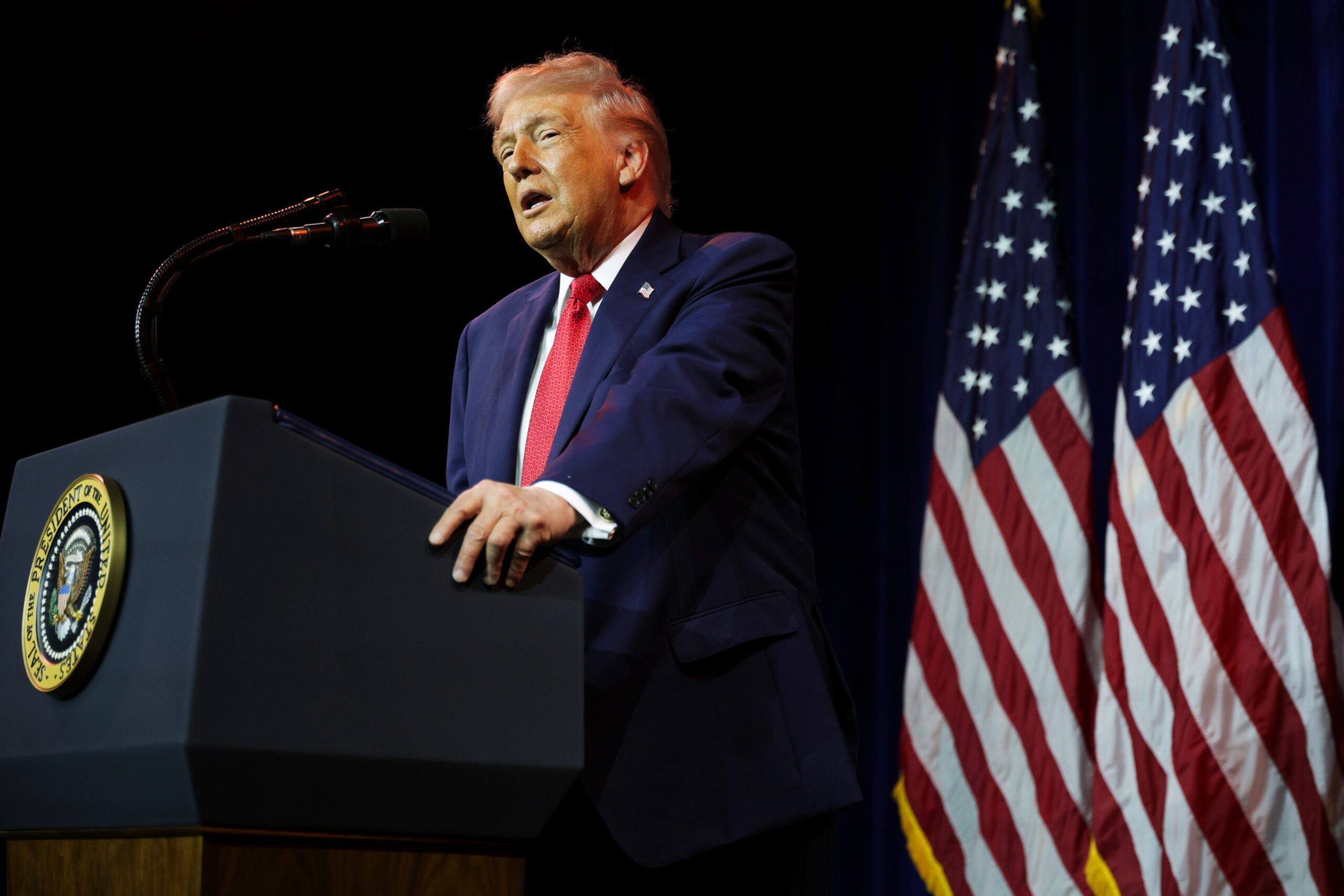
President Donald Trump offered two new proposals this week aimed at the stubbornly complex issue of home affordability.
Trump on Wednesday said he would move to ban institutional buyers from the housing market. Then on Thursday, he proposed a mortgage bond program aimed at lowering mortgage rates.
Will either achieve their targets? Experts are skeptical. Two previous proposals from the Trump administration — opening federal lands to housing development and introducing 50-year mortgages — mostly brought shrugs and, so far, have yet to yield results.
The proposed ban on institutional buyers
“For a very long time, buying and owning a home was considered the pinnacle of the American Dream,” Trump posted Wednesday on Truth Social. “I am immediately taking steps to ban large institutional investors from buying more single-family homes, and I will be calling on Congress to codify it. People live in homes, not corporations.”
For decades, many rental apartments in the United States have been owned by large landlords with thousands or tens of thousands of units. During the Great Recession, a new breed of landlord turned that business model to single-family homes.
Those buyers helped stabilize a housing market in free fall, and today the largest institutional owner of houses, Invitation Homes, holds about 85,000 single-family homes nationally, according to its latest annual report.
Concern about the role of these large buyers is nothing new. In 2023, two Democrats — Oregon Sen. Jeff Merkley and Washington Rep. Adam Smith — proposed a bill with a similar ban. “Congress must take action to crack down on corporate greed and get hedge funds out of the single-family home market,” Smith said at the time. In February 2025, they reintroduced similar legislation.
However, neither bill went anywhere.
How much do these buyers drive the market? That’s unclear, but according to Redfin, real estate investors of all sizes — small, individual investors and large institutions — bought 17% of U.S. homes that sold in the third quarter of 2025, up from 16% a year earlier.
Institutional buyers typically aren’t as active in the Northeast and Midwest, where home prices have spiked in the past couple of years. Invitation Homes, for instance, owns 3,500 houses in Chicago and Minneapolis, but the other 80,000-plus houses are spread across California, Texas, Florida and other Sun Belt states.
The argument against a ban
Banning big buyers might make homes more affordable by reducing some competition for homes. However, the housing market is slowing in some places — home sellers in Texas and Florida want to be able to sell to anyone right now, investor or not.
Proposed bans on institutional investors tap into widespread fears about Wall Street invading Main Street, along with notions about who owns a house. It’s fine for a publicly traded company to own a home if it’s a rental unit with a balcony and an elevator, but not if that home has a picket fence, a garage and a backyard.
But there’s also a theory that too much regulation of the housing market will scare away new development — an important consideration given the widespread agreement that the national housing market is running millions of homes short and needs more supply.
According to Bennie Waller, a finance and real estate professor at the University of Alabama, and Ken Johnson, a finance and real estate professor at the University of Mississippi, a blanket ban would hurt the housing market in the long run.
“With the free entry and exit by professional investors in the housing market, home prices will reflect investor knowledge, and all U.S. households will benefit from this extra knowledge as sold prices will now reflect a greater understanding of both price and risk,” Johnson and Waller write in an analysis of Trump’s proposal.
“A more informationally efficient housing market (one with free entry and exit for all) will attract more capital. Growing levels of capital will increase the amount of housing inventory. The opposite is true for a less informationally efficient housing market and will result in less inventory. In this time of inventory shortage, it does not seem wise to restrict investors and their capital from the housing market.”
The $200 billion mortgage bond move
A day after his bombshell on home buying, Trump announced he planned to wade into the market for mortgage-backed securities in a bid to drive down mortgage rates.
“Because I chose not to sell Fannie Mae and Freddie Mac in my First Term, a truly great decision, and against the advice of the ‘experts,’ it is now worth many times that amount — AN ABSOLUTE FORTUNE — and has $200 BILLION DOLLARS IN CASH,” Trump wrote on social media. “Because of this, I am instructing my Representatives to BUY $200 BILLION DOLLARS IN MORTGAGE BONDS.”
That was followed by a post on X from Bill Pulte, head of the overseer of Fannie Mae and Freddie Mac, that “Fannie and Freddie will be executing” the order.
Fannie Mae and Freddie Mac are the government-sponsored entities that ultimately issue about two-thirds of U.S. home loans. Those mortgages are packaged as securities and sold to pension funds and other institutional investors. So while your home loan might be originated by a lender such as Rocket, loanDepot or Wells Fargo, or by an independent mortgage broker, it soon is turned into a mortgage bond owned by an investor. This arcane process allows mortgages to be issued en masse, and it’s part of the reason nearly two-thirds of Americans own their homes, a high level by global standards. If the government steps in and buys additional bonds based on mortgages, the increased demand for home loans could lead to lower mortgage rates.
Mortgage rates dipped and mortgage stocks spiked on Trump’s proposal. But there was skepticism that the move would create sustained relief for mortgage rates.
“Details remain limited, but it’s difficult to see this proposal moving mortgage rates in a large or lasting way,” says Joel Berner, senior economist at Realtor.com. “A one-time infusion of roughly $200 billion, or even a series of smaller purchases that add up to that figure, is unlikely to meaningfully alter long-term mortgage pricing.”
While $200 billion sounds like a lot, it’s just 10% of the amount of mortgage-backed securities owned by the Federal Reserve, which holds $2 trillion of such instruments.
“When similar actions by the Federal Reserve have lowered rates in the past, it’s because markets viewed those purchases as large, sustained and predictable,” Berner says. “Without that same level of scale and credibility, any impact on mortgage rates would likely be modest and short-lived.”
What policies could affect home affordability?
There’s really no easy fix. Home prices are driven by supply and demand, while housing affordability is a function of home prices, mortgage rates and wages.
There’s a broad consensus among economists that too few homes have been built in the United States since the Great Recession, and that has led to a shortage of homes that has created upward pressure on prices.
“As with other housing policy ideas focused on demand, the larger issue is that the market’s core challenge remains on the supply side,” Berner says. “Without meaningful gains in construction, the long-term impact would be minimal, aside from a potential one-time boost to home prices.”
There’s not much the federal government can do to spur building. Approvals of new developments generally come at the local level, and local residents’ opposition to new construction can sway municipal officials against approving new developments.
Why we ask for feedback
Your feedback helps us improve our content and services. It takes less than a minute to
complete.
Your responses are anonymous and will only be used for improving our website.
Help us improve our content
Thank you for your
feedback!
Your input helps us improve our
content and services.
Read the full article here